

When the work is there but the people aren’t

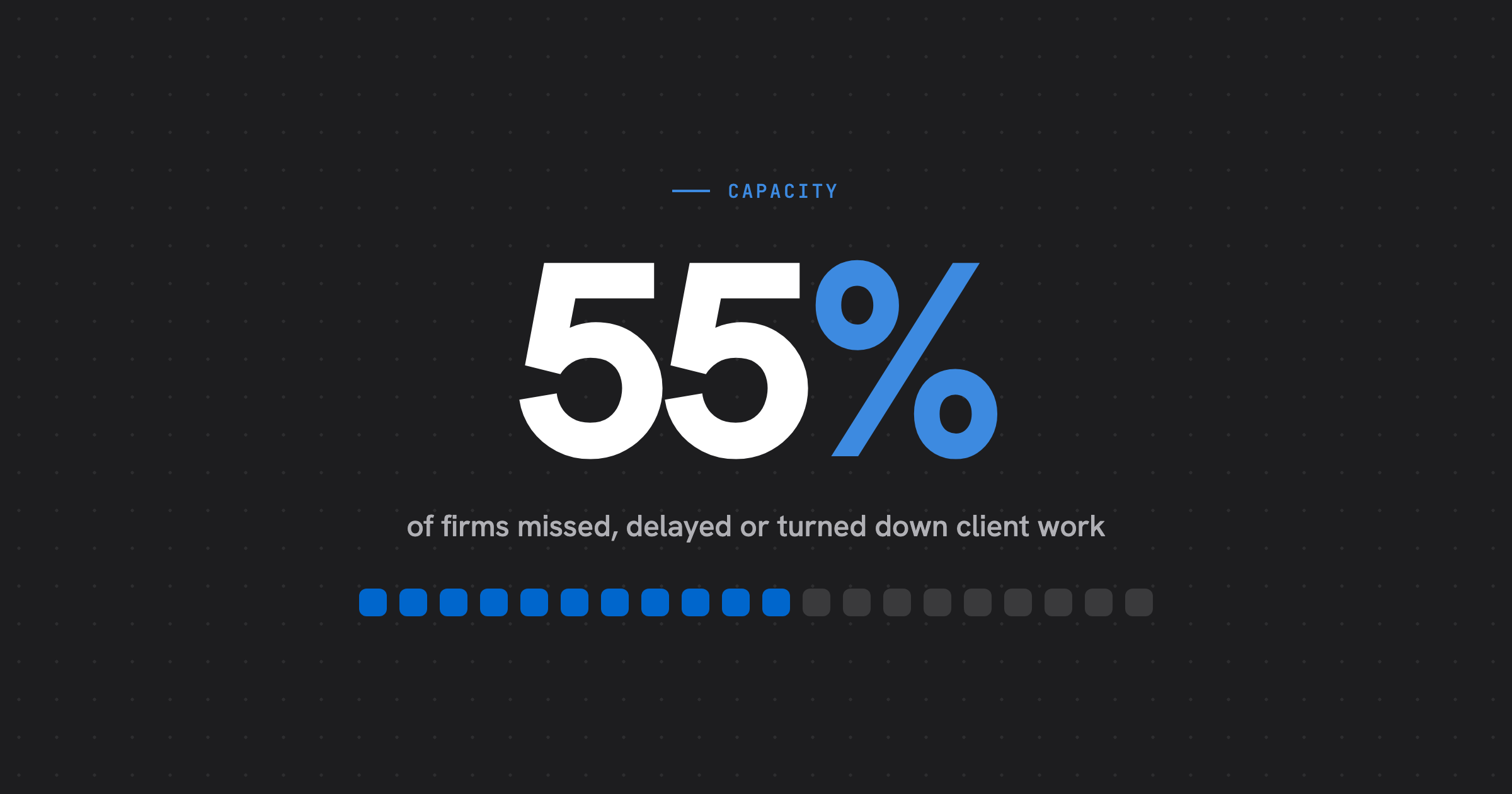
Most professional services firms don’t have a demand problem. They have a delivery problem. In Dayshape’s latest research, Professional services: Navigating a new operating era, 55% of firms said they had missed, delayed or turned down client work because of capacity constraints. In plain terms, the client was ready and the people weren’t.
These aren’t small practices stretched thin. The survey, carried out in June 2026, asked 400 C-suite and senior leaders at UK and US firms with 750 or more employees, across consulting, accounting, audit, tax and law. They are established firms with established pipelines, and more than half of them are leaving revenue on the table.
Every one of those moments is a cost that never shows up on a P&L. The proposal that wasn’t submitted. The extension that went to a competitor. The relationship that cooled because the honest answer was “not until Q3”.
A miss, a delay and a no do different damage
It’s worth separating the three, because each one hurts in a different way.
- A miss is invisible. The work goes elsewhere, often before you knew it existed, because your partners had quietly stopped bidding for things they couldn’t staff.
- A delay is visible to the client. You win the work but start late, or start with the wrong team, and the first impression of the engagement is a compromise.
- A no is the most honest of the three, and the most expensive. You’ve told a client to find someone else, and some of them won’t come back.
All three come from the same root cause: capacity that is fixed while demand is not.
The real issue is fit, not headcount
The instinctive response is to hire. But the same research suggests the problem isn’t simply the number of people on the payroll. 39% of firms said they regularly staff projects based on who is available rather than who has the best-fit skills. 53% said poor resourcing decisions regularly reduce project margin. And 44% regularly make significant changes to workforce plans once delivery is already underway.
Put together, that describes a familiar cycle. The firm has people, but not the right people at the right moment. The nearest available consultant gets stretched across a brief they aren’t ideally suited to. Margin erodes, the plan changes mid-flight, and the next opportunity arrives while the team is still recovering from the last one.
The firms losing work to capacity rarely lack people. They lack the right people, available at the moment the client says yes.
You can’t forecast your way out of it
Better planning helps, but it has limits. Only 4% of firms in the Dayshape survey said they could accurately forecast workforce capacity beyond 12 months, and 47% still rely on spreadsheets or static reports to plan their workforce. Over a third (35%) named talent shortages as a constraint on growth.
That isn’t a criticism of resourcing teams. Demand in professional services is lumpy by nature: a regulatory change, a deal closing, a transformation programme approved overnight. No forecast will tell you in January that a client will need three supply chain specialists in July. Permanent hiring takes months, and a hire made for a spike becomes fixed cost once the spike has passed.
Design capacity in, rather than chasing it
The firms handling this well treat flexible capacity as part of the operating model, not an emergency measure. Instead of starting from the payroll and asking who is free, they start from the work and ask who is best. Then they draw on a bench of vetted independent associates to close the gap between the two.
In practice, that comes down to four things:
- A private pool built around your sectors and service lines, so the specialist you need has been vetted before the brief arrives.
- Associates contracted on your own terms, so bringing someone in takes days rather than a fresh round of negotiation.
- Visibility your partners can use at the proposal stage, so they bid with a named team in mind instead of walking away.
- A dedicated owner who knows your pipeline and can see demand coming before it lands.
With those in place, the answer to a client changes from “not until Q3” to “we can start next week, and here’s who’ll be on it”. Your permanent team stays focused on the work only it can do, and the bench flexes around it.
Turning a constraint into an advantage
There’s an opportunity hidden in that 55%. If more than half of your competitors are missing, delaying or declining work for want of capacity, the firm that can reliably say yes has a real edge. Not because it’s bigger, but because it’s more responsive.
That’s what we build at Project Blackbook: benches of independent associates drawn from the top 3% of a 40,000-strong community, managed end-to-end and shaped around the work you do. Our member firms mobilise 75% faster from brief to bench, and 50% more cost-effectively than permanent headcount. Your capacity moves with your pipeline, not behind it.
The next time a client is ready to buy, the question shouldn’t be whether you have the people. It should be which of them you’d like to put forward.