


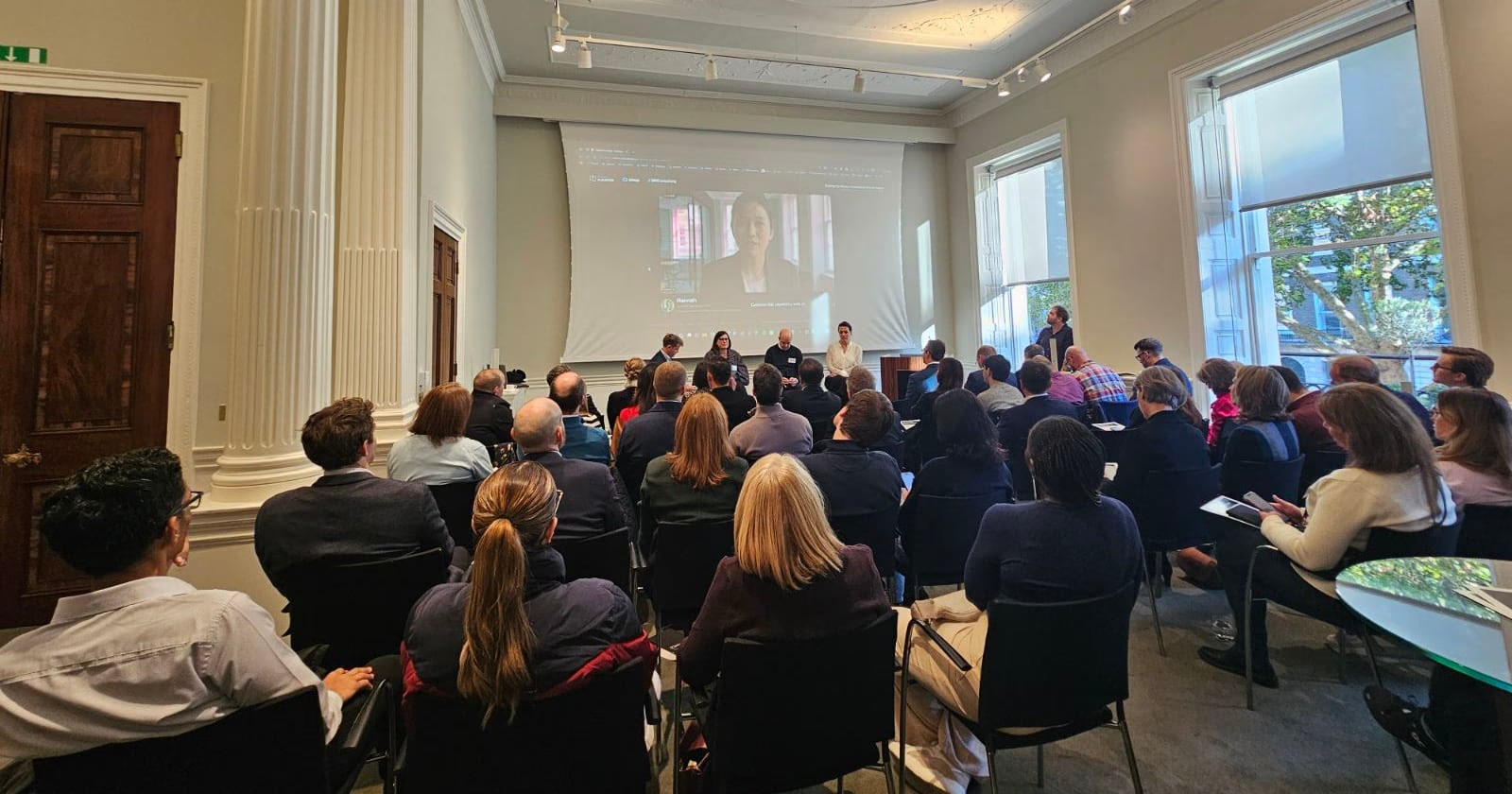
On 22 October we co-hosted a breakfast panel in London with SBR Consulting and CMap for managing directors, partners and CEOs of consulting firms. I chaired it. Ellen Price, Head of Professional Services at SBR Consulting, Duncan Ramsay, Partner at ECI Partners (whose portfolio includes CMap), and Teresa Allan of Magnus Consulting each brought a different view of the same question: how does a consultancy grow on purpose rather than by luck?
The answer kept coming back to one word: predictability. A consultancy growth engine is the set of habits that makes new work arrive on purpose: a clear ideal client, more than one person who can originate, the capacity to say yes quickly, and pricing that rewards outcomes. A firm whose growth depends on two rainmakers, three large clients and a bench that is either overstretched or idle doesn’t have one. It has a run of good fortune.
What differentiates a professional services business is repeatability, scalability and predictability. — Duncan Ramsay, ECI Partners
These are the six lessons we took away, what they mean for your 2027 plan, and a short checklist to act on. SBR has also published the full playbook from the morning, which we wrote together with SBR Consulting and CMap.
Key takeaways
- Build trust in the firm, not in two or three rainmakers. Start with an ideal client profile everyone shares.
- Treat origination as its own skill and career path, and watch client concentration above 10% of revenue.
- Independent consultants are a growth channel as well as delivery capacity. They hear the next need first.
- Speed to staff work is a growth lever: 55% of firms have missed or turned down work for lack of capacity.
- Use AI to improve deal quality, not volume, and keep people on the commercial judgement calls.
1. Make the firm the brand, not the rainmakers
In many consultancies, client trust sits with a handful of partners rather than with the firm. That’s a growth risk, and investors see it straight away. Duncan described how closely ECI looks at whether new business is concentrated in one or two people. If one partner originates most of your new work and then leaves, the pipeline leaves with them.
The fix starts with an ideal client profile that the whole firm shares. Research from Fullcast, Pavilion and SBR found that 63% of CROs have little or no confidence in their ICP, and that ICP misalignment can cut win rates by up to 75%. Alignment matters too. Magnus Consulting found that only 35% of go-to-market leaders are very confident of hitting their growth targets, rising to 58% where sales and marketing are fully aligned. Teresa’s advice was to work backwards. Start from the challenges your best clients face, identify the triggers that make them buy, and only then choose your channels.
After that, let proof do the selling. Case studies tied to the trigger that started the work travel further than capability statements. So do referrals, if you ask for them: Ellen pointed to the widely quoted finding that more than nine in ten people say they would give a referral, yet only 11% of us ask.
2. Fix origination, not just account growth
Selling to an existing client is far easier than winning a new one. A widely quoted Marketing Metrics benchmark puts the odds at 60 to 70% for an existing client and 5 to 20% for a new prospect. So most firms drift towards farming, and the catch is concentration risk. As I put it on the day, if your flagship client walked tomorrow, would the firm be in serious trouble?
Duncan was clear about how investors see it. A commonly cited private equity comfort zone is more than 30% of revenue from new clients and no single client above 20%. “Once a client passes 10% of your revenue, we want to understand the relationship,” he said. Past 30%, it gets hard to justify.
Ellen’s diagnosis was that many consultancies have an origination problem. “The pinnacle of consulting is sales,” she said. Her answer is to treat business development as a real career path, to see hunting and farming as different skills rather than different levels of seniority, and to stop treating “hunter” as a dirty word.
The right model depends on what your clients buy. If they buy a team and a method, a hunter and farmer split can work well. If they buy one person’s expertise, putting a separate salesperson in front of that expert tends to frustrate them. Either way, check that partner economics, delivery targets and long-term account plans reward the behaviour you want, and bring procurement into key account plans early.
3. Treat independent consultants as a growth channel
This was the point I pushed hardest on the day. Most firms think of independent consultants as delivery capacity: the people you call when the bench is full. They are also some of the best-placed sources of new work you have.
Independents are a growth channel, not only delivery capacity. They’re on site, so they hear the next need first.
An associate embedded in a client programme hears about the next problem before it reaches a tender. Reward them for passing it on, with an introducer fee or a share of the follow-on work, and they will help you farm the account. Senior independents also bring their own networks, and on a bid they add named, credible expertise without adding fixed cost to your bench.
That only works if the relationship is built for it: associates you have vetted, contracted on your own terms and kept close, rather than strangers sourced in the week the work lands. It is the same shift we describe in why organisations are switching to flexible teams: the independent bench becomes an extended part of your team, not a last resort.
4. Make speed to respond a growth lever
Winning the work is half the job. The other half is saying yes with the right people. Dayshape’s October 2026 research, a survey of 400 senior leaders at UK and US firms, found that 55% had missed, delayed or turned down client work because of capacity constraints, and 53% said staff availability and skills matching were hitting their margins. We looked at those findings in more detail in When the work is there but the people aren’t.
Ellen made the point that strategy is also about what you decline. A light triage step that filters incoming demand against your core propositions stops the firm chasing everything, and what it learns should flow back to delivery.
Duncan offered a simple predictability test. Can you forecast demand accurately? Can you price it well? Can you use that visibility to manage resourcing and utilisation? Can you get invoices out and cash in on time? Firms without subscription revenue can still build recurring income through retainers and managed services.
Teresa’s advice on scaling was to grow through frameworks and intellectual property first, let data and AI do the heavy lifting, and prove a piece of work is repeatable before adding headcount.
Two practical fixes came out of the discussion: live visibility of who is available, with which skills and from when, and a vetted bench of independents you can draw on when demand spikes. To see where you stand today, run the Monday test: take a realistic client request and time how long it takes to confirm a named, available, suitably skilled team. If the answer is weeks rather than days, that is where your growth is leaking.
5. Use AI to improve deal quality, not volume
AI is already shaping go-to-market thinking, but not yet many decisions. Magnus Consulting found that 81% of leaders say AI has a significant influence on their go-to-market, but only 18% use AI insight as a primary input to decisions. How it’s used matters. In the Fullcast, Pavilion and SBR research, organisations that used AI to improve deal quality grew revenue per seller by 61%, while those that used it to flood the top of the funnel saw it fall by 26%.
The most useful application the panel described was signal monitoring. AI watches for client triggers in real time, and a weekly review asks three questions of each signal. Does it matter? Does it fit our strategy? Does it need action? People still validate the evidence and make the commercial call. Ellen’s warning was that AI scales whatever practice you already have, good or bad. Speed up a weak process and you just get faster caterpillars, so a clear sales methodology has to act as the guardrail.
Hannah, an AI coach from Replicate Labs, took questions from the room and showed what this looks like in practice: a rehearsal partner for meeting preparation, follow-up and role-play, not a replacement for human coaching. Her advice for first meetings was to open with a hypothesis and sharp questions, not credentials.
For investors, AI only adds value when there is quantified evidence that it gives the firm a lasting edge.
6. Work through the messy middle of outcomes-based pricing
Pricing was the final lever. The options range from selling change rather than hours, to value-based pricing, to layered fees that combine a base fee with success or technology fees. Many firms will need a transitional model first, such as fixed-price agile delivery. Whatever the model, agreeing KPIs with the client up front and measuring impact against them helps you win the next piece of work.
A consultancy growth checklist for 2027 planning
This week
- Write your ICP in one sentence, and ask three partners to do the same.
- Ask one happy client who else you should be talking to.
- Run the Monday test on a realistic client request.
This month
- Start a weekly sales, marketing and account review built around client triggers.
- Map who really originated last year’s new business.
- Put procurement on every key account plan.
Before you lock your 2027 plan
- Test your long-term vision with your key accounts.
- Get a live view of who is available, with which skills, and from when.
- Build a vetted bench of independent consultants, with an introducer model.
Frequently asked questions
What is a consultancy growth engine? It is a repeatable way of winning and delivering new work that doesn’t depend on a few individuals: a shared ideal client profile, origination spread across the firm, a pipeline you can forecast, and capacity you can mobilise when the client is ready.
How much revenue should come from one client? Investors start asking questions once a single client passes 10% of revenue. A commonly cited private equity comfort zone is no single client above 20%, with more than 30% of revenue coming from new clients.
How can independent consultants help a consultancy grow? They add named, senior expertise to bids without adding fixed cost, let you staff work quickly when demand spikes, and, because they sit inside client programmes, often hear about the next piece of work first. An introducer fee or a share of follow-on work rewards them for passing it on.
How should consultancies use AI in business development? Use it to watch for client triggers and improve the quality of each opportunity, not to flood the funnel. Research from Fullcast, Pavilion and SBR found the first approach grew revenue per seller by 61%, while the second cut it by 26%.
Where Project Blackbook fits
The last two items on that list are what we do. Project Blackbook builds and manages private benches of independent consultants for management consultancies, drawn from the top 3% of a 40,000-strong community. Our member firms mobilise 75% faster from brief to bench, and 50% more cost-effectively than permanent headcount, so you can say yes when the client is ready. See how membership works, or use the associate vs permanent hire calculator to compare the cost of flexible capacity.
Thank you to Ellen, Duncan, Teresa and Hannah, to our co-hosts at SBR Consulting and CMap, and to everyone who joined us for the consultancy growth engine breakfast.